Cluster operations
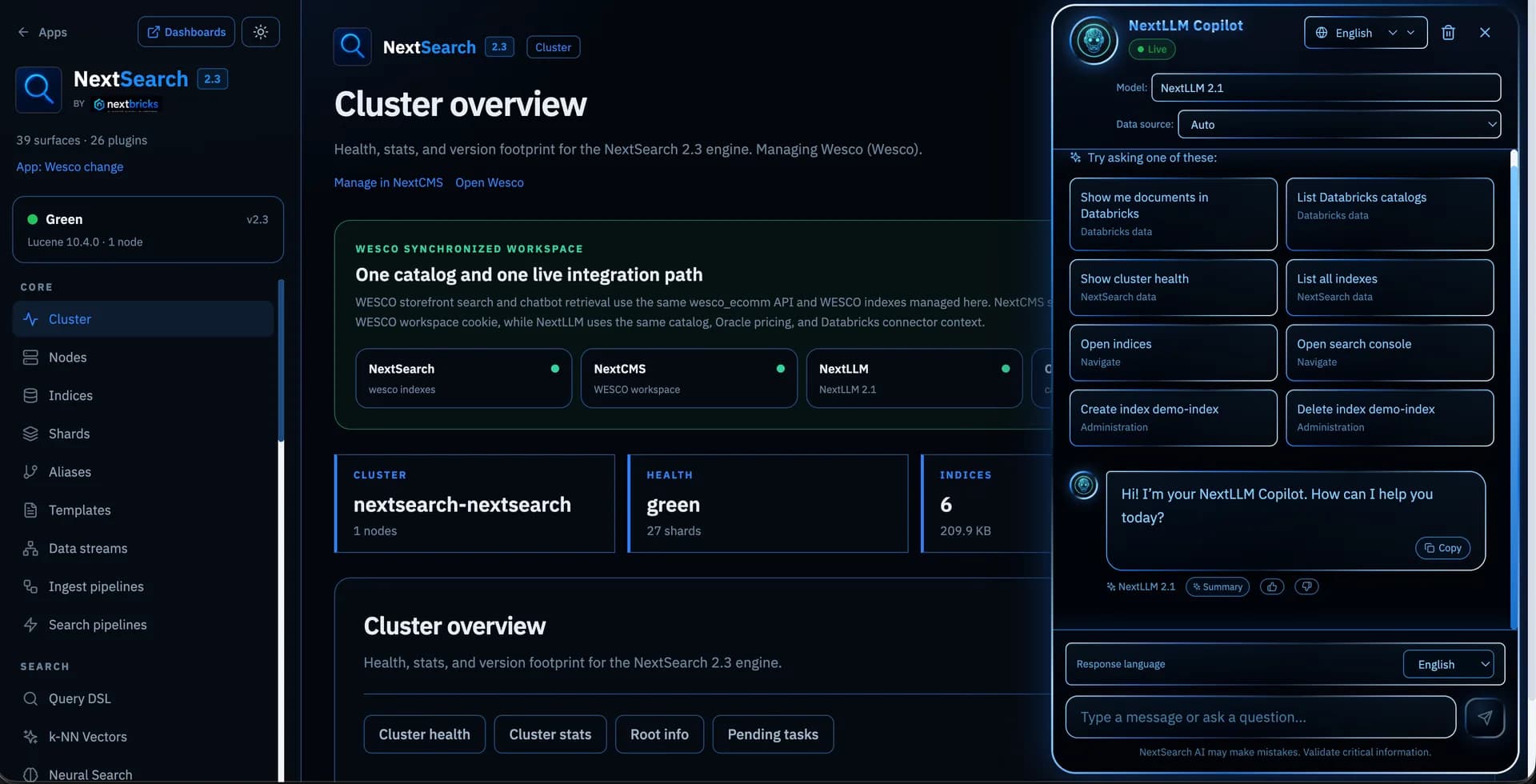
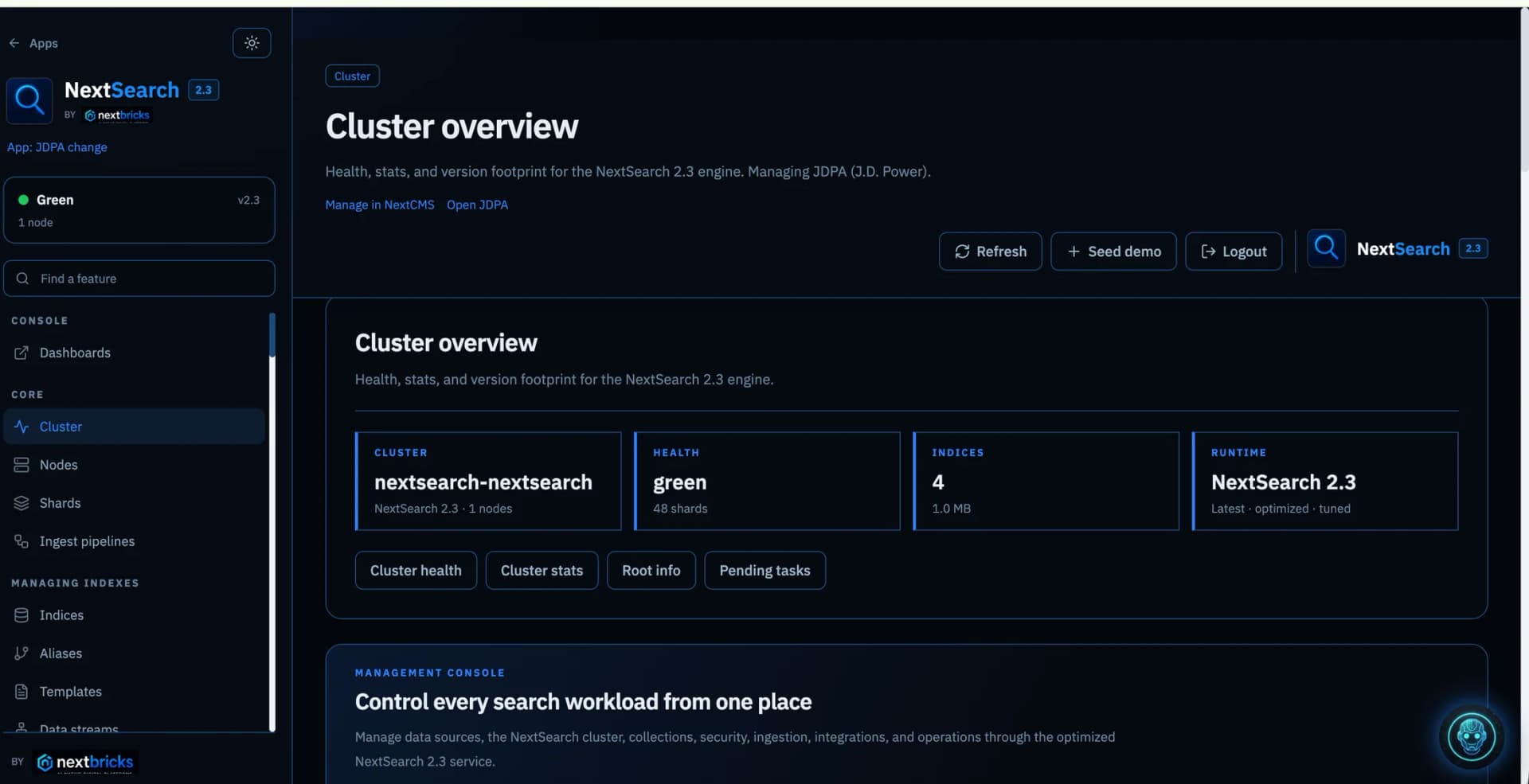
See nodes, shards, indexes, templates, data streams, pipelines, and health in one operator workspace.

Move from Elasticsearch or Elastic Cloud to NextSearch—an AI-native enterprise search engine built for speed, operational clarity, and control. We benchmark your real workload before you commit.
Same hardware. Same workload.
In the published same-hardware comparison, NextSearch delivered 1.94× the throughput of Elasticsearch 9.3.1 while using roughly one-third of the memory.
Benchmark results are evidence, not a blanket guarantee. We repeat the test with your data, queries, and acceptance criteria before recommending a move.
What NextSearch is
NextSearch brings cluster administration, migration testing, relevance work, hybrid retrieval, RAG workflows, and AI-assisted operations into one deployable platform.
See nodes, shards, indexes, templates, data streams, pipelines, and health in one operator workspace.
Run current queries against the target and compare response shape, latency, and search behavior before cutover.
Combine lexical, vector, semantic, and neural-search patterns for product discovery, knowledge search, and RAG.
Use an embedded assistant for health checks, index discovery, troubleshooting, and routine administration.
Track workload health, query behavior, performance, relevance signals, and content gaps continuously.
Bring catalogs, documents, CMS content, application data, and enterprise sources into one governed flow.
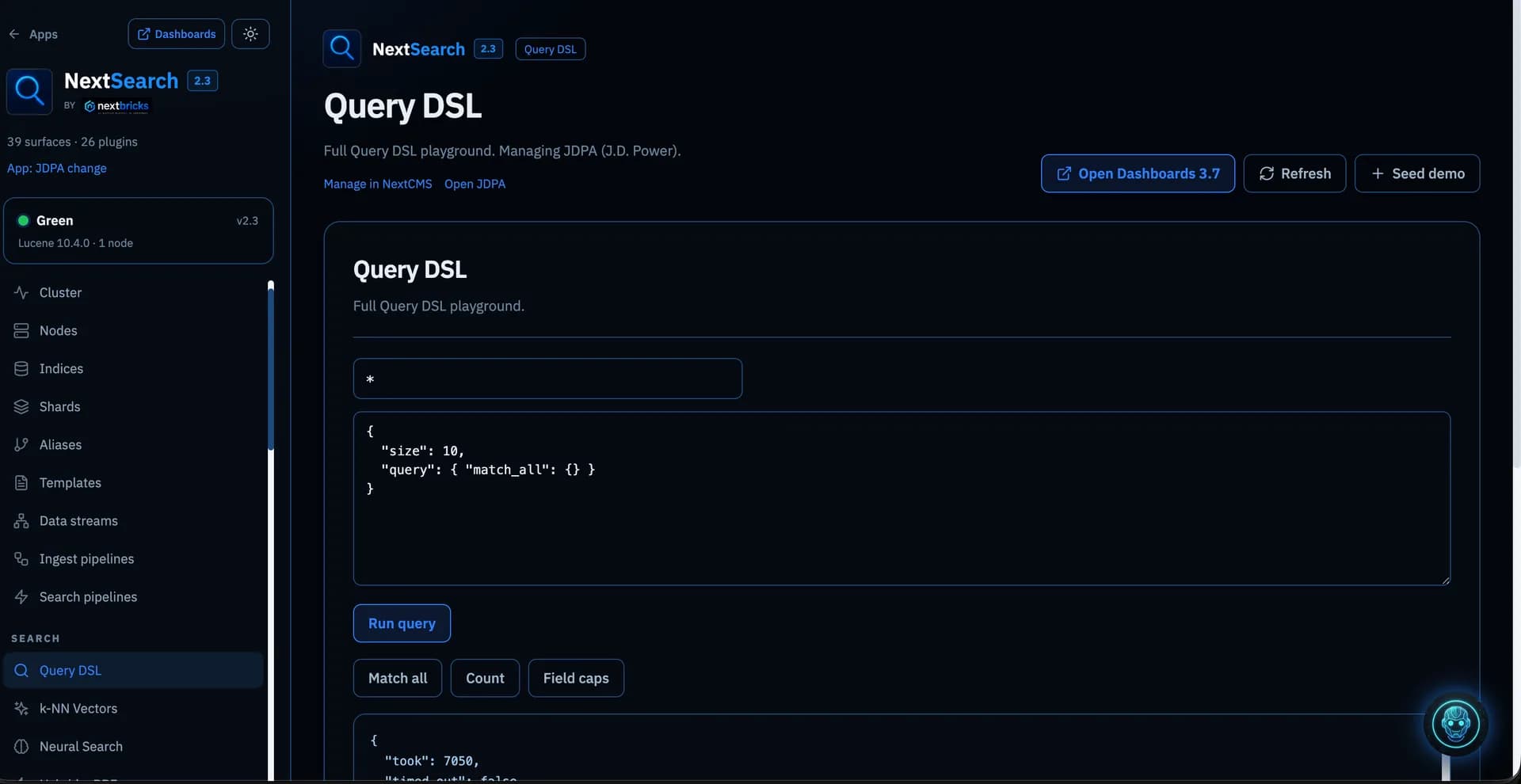
Migration workspace
Run match-all, count, field-capability, and custom JSON queries against the target in a focused validation workspace.
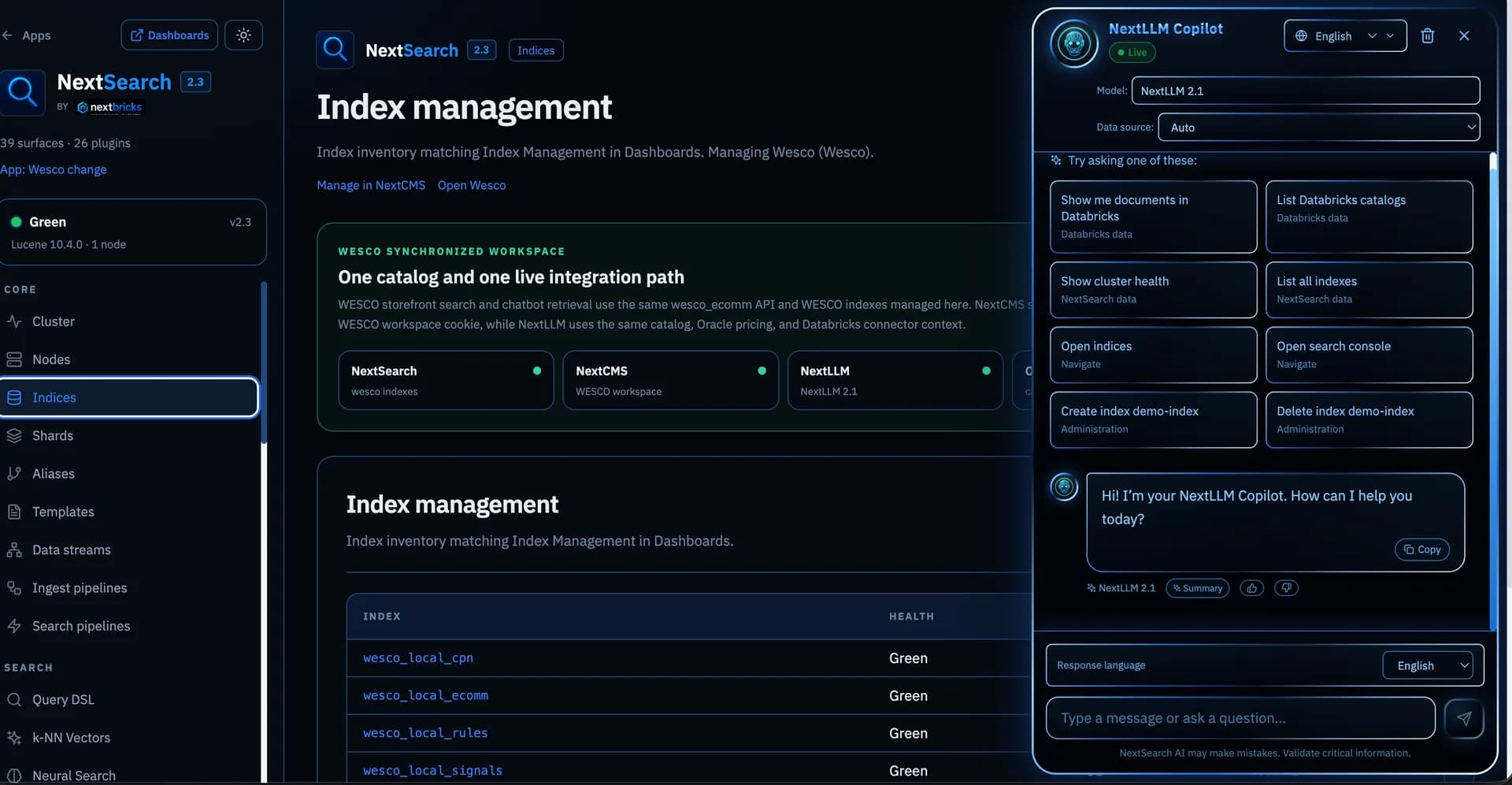
One operator flow
Inspect index inventory, connect NextCMS and NextLLM, and use the copilot without bouncing between fragmented consoles.
A responsible search migration is not a one-click index copy. We prove data fidelity, API behavior, relevance, latency, throughput, security, and recovery before cutover.
Capture versions, plugins, mappings, clients, pipelines, query patterns, security, data volume, and service objectives.
Measure indexing throughput, p95 and p99 latency, relevance, resource use, failure modes, and current operating cost.
Compare APIs, analyzers, aggregations, lifecycle controls, dashboards, security, and operational dependencies.
Move production-shaped data, replay traffic, compare results, test recovery, and document rollback conditions.
Synchronize changes, route traffic in controlled stages, and monitor explicit acceptance criteria.
Tune from real workload evidence and establish ownership, capacity, patching, and upgrade routines.
Leave Elastic Cloud on your terms
Bring your Elastic Cloud architecture and bill. We will isolate the workload, infrastructure, support, and migration costs—then show whether NextSearch earns the move.
Support that stays after cutover
Direct answers
NextSearch is an enterprise search operations and migration platform from NextBricks. It combines index administration, Query DSL testing, cluster health, lexical and vector retrieval, connected data workspaces, and an embedded NextLLM Copilot.
NextSearch is designed as an evaluation and migration target for compatible Elasticsearch workloads. Nextbrick first inventories APIs, mappings, analyzers, plugins, security, integrations, and operating requirements, then validates the target with production-shaped data and traffic before any cutover.
The published comparison used the same hardware and workload for NextSearch and Elasticsearch 9.3.1. Results should be treated as a benchmark, not a universal guarantee; Nextbrick repeats the test with each customer's data and query mix before recommending migration.
Yes. The migration method supports production-shaped rehearsals, dual-running, staged traffic routing, explicit acceptance criteria, and a tested rollback window.
Nextbrick supports architecture review, compatibility mapping, data movement, Query DSL validation, relevance testing, performance benchmarking, security planning, incident response, cutover, and ongoing NextSearch operations.
Share your current engine, hosting model, index volume, traffic, latency target, relevance requirements, integrations, budget, and timeline. We’ll turn it into a practical benchmark and migration plan.