NextBrick
Back to products
AI Search Platform

NextSearch

Hybrid keyword, vector, semantic, and rules-driven search in one enterprise control plane.

NextSearch gives teams the search relevance, retrieval, personalization, analytics, and operational governance they usually stitch together across Elasticsearch, Coveo, Lucidworks, OpenSearch, and Solr.

Positioned to replace

Elasticsearch 9.4, Coveo, Lucidworks, OpenSearch 3.6, Solr 10

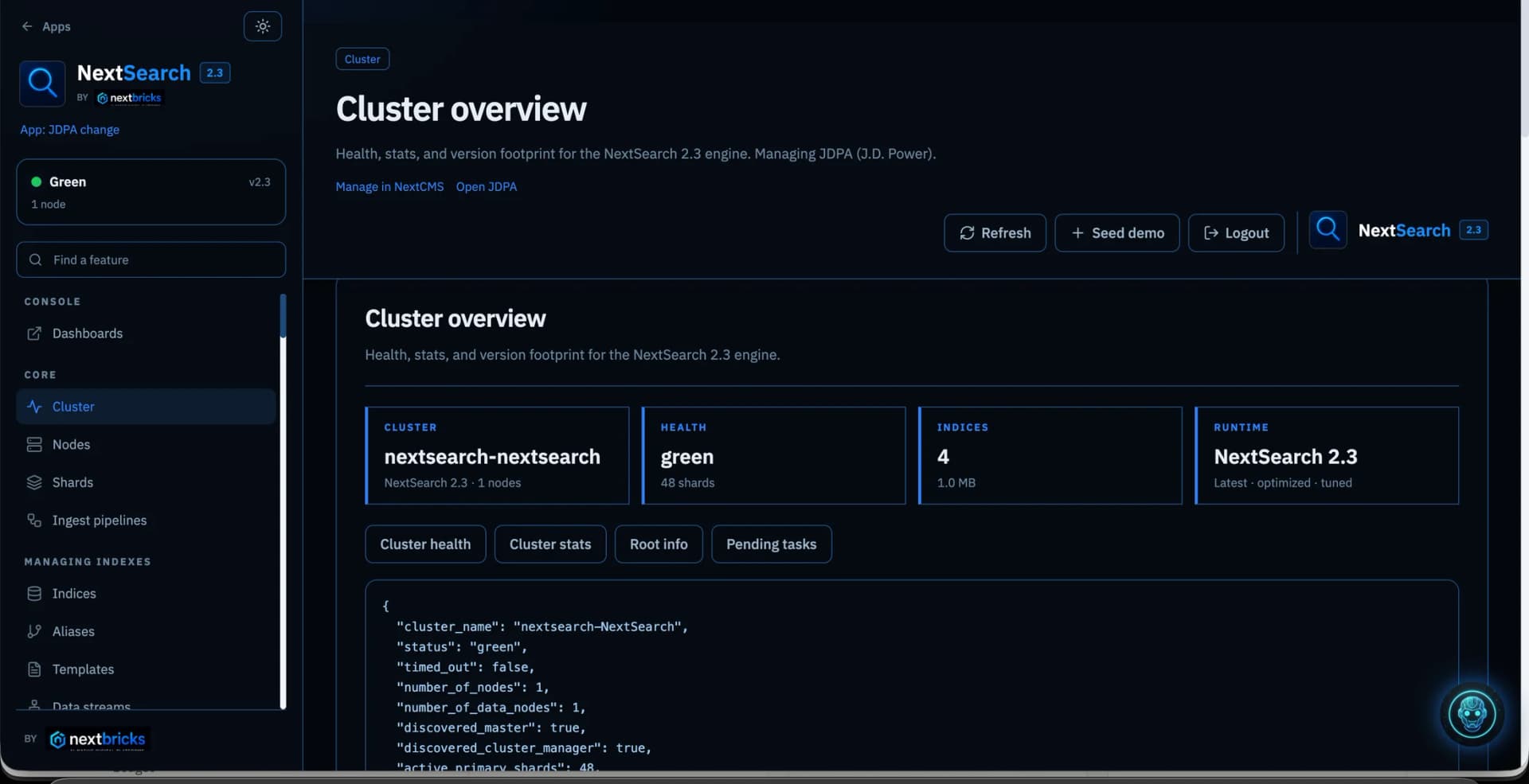
NextSearch product interface

Hybrid

BM25 + vector + semantic retrieval

Rules

Query rules, boosts, synonyms, facets

Live

Search quality and latency telemetry

What Makes It Different

A productized NextBrick operating layer built around real enterprise workflows, not a thin wrapper around one vendor.

Relevance Studio

Tune boosts, facets, synonyms, query rewriting, and ranking rules from a governed UI.

Vector Search Ready

Run hybrid retrieval for RAG, support search, product discovery, and enterprise knowledge portals.

Search Analytics

Track zero-result queries, top prompts, click behavior, latency, and content gaps.

Multi-Engine Operations

Operate Elasticsearch, OpenSearch, Solr, and vector stores with a consistent control layer.

Reviewed May 10, 2026

NextSearch 1.0 Local Review

The NextSearch 1.0 review documents a Lucene-powered search runtime with implemented core API compatibility, a CLI/server split, benchmark tooling, and a practical parity roadmap against OpenSearch and Elasticsearch.

Review Highlights

  • Built on Apache Lucene 10.4.0 modules including core, analysis-common, queryparser, and queries.
  • Runtime includes Java server and CLI implementations, Bash/YAML operations, and a Python benchmark harness.
  • Core APIs are mostly implemented: create/delete index, _search, _bulk, _doc CRUD, _aliases, _cat/indices, and _cluster/health.
  • Query support includes q, match, and multi_match, with bool/range/sort tracked as partial parity work.
  • Aggregations include terms and cardinality, with stats and date histogram marked for upcoming parity expansion.

Parity and Deployment Notes

  • The reviewed local URL returned a frontend SPA shell, so API parity verification should target the confirmed NextSearch backend listener directly.
  • The current license policy allows permissive licenses and blocks copyleft or service-restricted licenses for core dependency intake.
  • Security, multi-tenant controls, and distributed durability remain roadmap items for full OpenSearch and Elasticsearch parity.
Enterprise Search Engine Battlecard 1.0

1.94x faster than Elasticsearch at half the p99 latency.

Same hardware, same index, one JAR, no Docker bloat, no enterprise license lock-in.

Battlecard

Versus Elasticsearch, Solr, and OpenSearch

1.85x faster than Solr 10

1.94x faster than Elasticsearch

2.73x faster than OpenSearch

$650K saved vs Elastic Cloud

MetricNextSearchSolr 10ES 9.3.1OpenSearch
QPS3,1741,7121,6391,163
p50 latency8.65 ms14.12 ms15.59 ms19.32 ms
p95 latency19.67 ms42.79 ms39.62 ms72.68 ms
p99 latency39.41 ms94.53 ms59.75 ms134.25 ms
RAM snapshot327 MiB742 MiB982 MiB918 MiB
Image sizeSingle JAR756 MB989 MB1.25 GB
Highest QPS on identical hardware running the same workload.
3x lower RAM than major search engines, suitable for edge nodes and smaller VMs.
Apache 2.0 core with no ELv2 lock-in.
AI-native retrieval with dense, sparse, ColBERT, semantic rerank, and agent-callable APIs.
NextSearch proof screen

Use Cases

  • Support knowledge search
  • Commerce product discovery
  • RAG retrieval layer
  • Enterprise intranet search

Why Teams Choose It

  • Own relevance logic
  • Avoid search black boxes
  • Unify lexical and semantic retrieval
  • Measure quality continuously

Product Modules

The product is packaged into clear capabilities so teams can adopt incrementally and expand as the platform matures.

Plan rollout
Indexes
Query Rules
Typeahead
Facets
Vector Retrieval
Analytics