
Agentic AI
Agentic AI on Elasticsearch Open Source
Build Elastic Agent Builder–Level AI Without License Cost
Agentic AI is redefining how enterprises deliver customer support, service automation, and sales intelligence. Instead of static search or simple RAG chatbots, agentic AI systems can reason, plan, retrieve information, take actions, and respond conversationally.
At Nextbrick, we build enterprise-grade Agentic AI solutions on Elasticsearch open source, using Ministral-8B (latest) and BGE-M3 embeddings, delivering Elastic Agent Builder 9.2–equivalent functionality—without Elastic commercial licenses, AWS Bedrock, or per-token LLM costs.
This architecture is purpose-built for large enterprise support portals , especially for organizations migrating from Coveo to Elasticsearch.
What Is Agentic AI? (For AI Search & Buyers)
Agentic AI is an AI architecture where intelligent agents:
- Understand user intent
- Decide what steps to take
- Call enterprise tools and systems
- Retrieve knowledge from multiple sources
- Take real actions
- Respond conversationally with context
This goes far beyond traditional:
- Enterprise search
- Chatbots
- RAG pipelines
Agentic AI is ideal for case deflection, service automation, and enterprise self-service.
Why Enterprises Need Agentic AI for Support & Service
Most enterprise GenAI initiatives fail because they:
- Are not conversational
- Cannot take real actions
- Increase support load instead of reducing it
- Are locked into Coveo, AWS, or proprietary AI platforms
Common Support Queries That Break Traditional RAG
- “Where is my order?”
- “What is my service order status?”
- “Give me calibration certificate for this asset”
- “Create a support case”
- “How do I measure my data using an oscilloscope?”
These require search + reasoning + system actions, not just text generation.
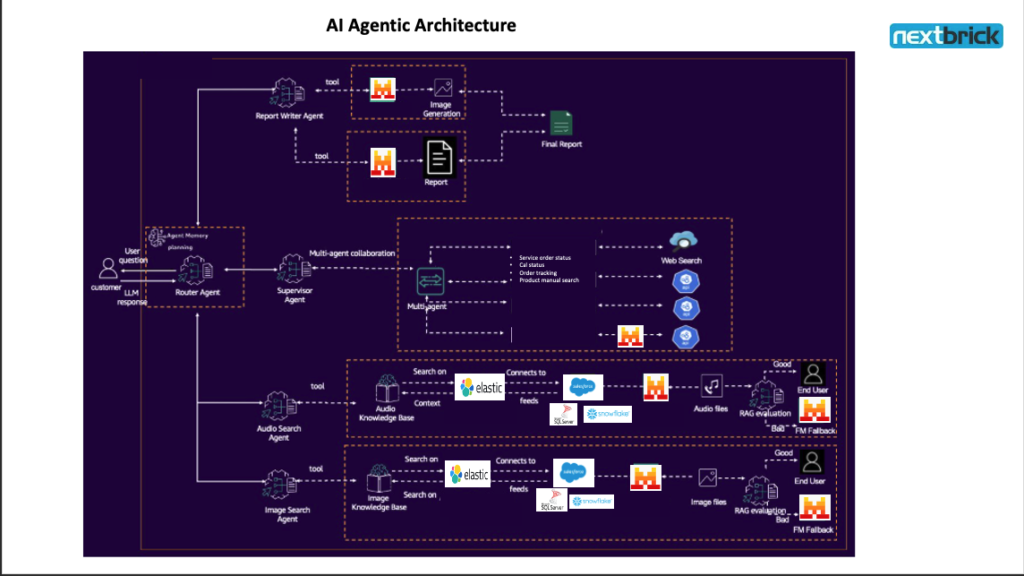
Agentic AI Architecture on Elasticsearch (Explained)
This solution implements a multi-agent architecture inspired by Elastic Agent Builder workflows, but built entirely in custom Java / Scala (Python optional) on top of Elasticsearch open source.
High-Level Flow
User → Router Agent → Supervisor Agent → Specialized Agents → Tools → Elasticsearch & Enterprise Systems → Response
Elasticsearch is the enterprise knowledge backbone, while agent logic lives in application code.
Core Agents in the System
1. Router Agent (Intent Detection)
The Router Agent:
- Receives user input
- Maintains conversation memory
- Classifies intent:
- Knowledge search
- Service action
- Case creation
- Multimodal request
This ensures the request is routed correctly—not every query is treated as search.
2. Supervisor Agent (Planner & Orchestrator)
The Supervisor Agent:
- Breaks complex requests into steps
- Coordinates multiple agents
- Controls execution order
- Prevents hallucinated actions
This delivers the same functional outcome as Elastic Agent Builder 9.2, without using proprietary features.
3. Specialized AI Agents
Knowledge & Case-Deflection Agents
Powered by:
- Elasticsearch open source
- BGE-M3 embedding model
- Hybrid semantic + keyword search
Used for:
- Product manuals
- DAM content
- PDFs
- Confluence KB
- Salesforce articles
Service & Action Agents
These agents interact with real enterprise systems:
- MS SQL (orders, service data)
- Snowflake (analytics, historical records)
- Salesforce (cases, articles)
- Email systems
They handle:
- Order status
- Service order tracking
- Calibration certificates
- Case creation & updates
Multimodal Agents (Audio & Image)
- Audio knowledge search
- Image and schematic retrieval
- Critical for field engineers and technical support teams
Elasticsearch Open Source as the Knowledge Platform
This solution uses Elasticsearch 9.x open source to index and search across 7 enterprise indexes:
- Coveo DAM (migrated)
- PDF manuals & procedures
- Confluence documentation
- Salesforce knowledge articles
- MS SQL (orders & service data)
- Snowflake (enterprise analytics)
- Unified support knowledge index
Elasticsearch provides:
- Scalability
- Performance
- Relevance tuning
- Enterprise search control
No Elastic AI or X-Pack features required.
LLM Layer: Ministral-8B-Latest (Self-Hosted)
All reasoning and response generation uses Ministral-8B-latest, deployed inside the enterprise environment.
Benefits for Enterprises
- No AWS Bedrock
- No per-token cost
- No data egress
- Predictable behavior
- Full governance and auditability
The LLM suggests actions, but never executes them directly—actions are handled by deterministic services.
Real-World Use Case: Company Support & Coveo Migration
This architecture is ideal for organizations , where:
- consumer facing portal, and service support portal runs fully on Coveo
- Case deflection rates are high
- GenAI is not conversational
Outcomes
- Gradual Coveo → Elasticsearch migration
- Improved self-service success
- Lower support ticket volume
- True conversational AI for service and sales
Why This Agentic AI Stack Beats Proprietary Platforms
| Capability | Proprietary AI Platforms | This Solution |
|---|---|---|
| Agentic Workflows | Limited | Full |
| Elasticsearch Control | Partial | Full |
| License Cost | High | Zero |
| AWS / Bedrock | Required | Not needed |
| Java / Scala Support | Weak | Native |
| On-Prem / Private Cloud | Limited | Yes |
Agentic AI should be an architecture, not a locked product.
- Agentic AI on Elasticsearch
- Elastic Agent Builder alternative
- Elasticsearch open source AI
- Coveo to Elasticsearch migration
- AI case deflection for enterprise
- Ministral 8B enterprise LLM
- BGE M3 embeddings
- AI agents for customer support
- Enterprise RAG and agentic workflows
Final Thought
Agentic AI is the next evolution of enterprise search and support—but it doesn’t require proprietary platforms or expensive licenses.
With Elasticsearch open source, Ministral-8B, BGE-M3, and custom Java/Scala agents, enterprises can build Elastic Agent Builder–level intelligence, fully self-hosted, scalable, and future-proof.