
Retrieval Augmented Generation (RAG) Consulting & Support
Design, deploy, and scale production RAG systems with clear governance, measurable retrieval quality, and enterprise-ready operations.
Improved answer accuracy with grounded retrieval
Reduced hallucinations through source-backed context
Real-time knowledge updates without model retraining
Enterprise-grade policy and compliance controls
Featured Videos
Product + RAG DemosRAG Use Cases
Customer support assistants
Internal policy copilots
Knowledge search across docs and wikis
Fraud, compliance, and analytical reporting
Sales enablement and product Q&A
Multimodal retrieval for text + media
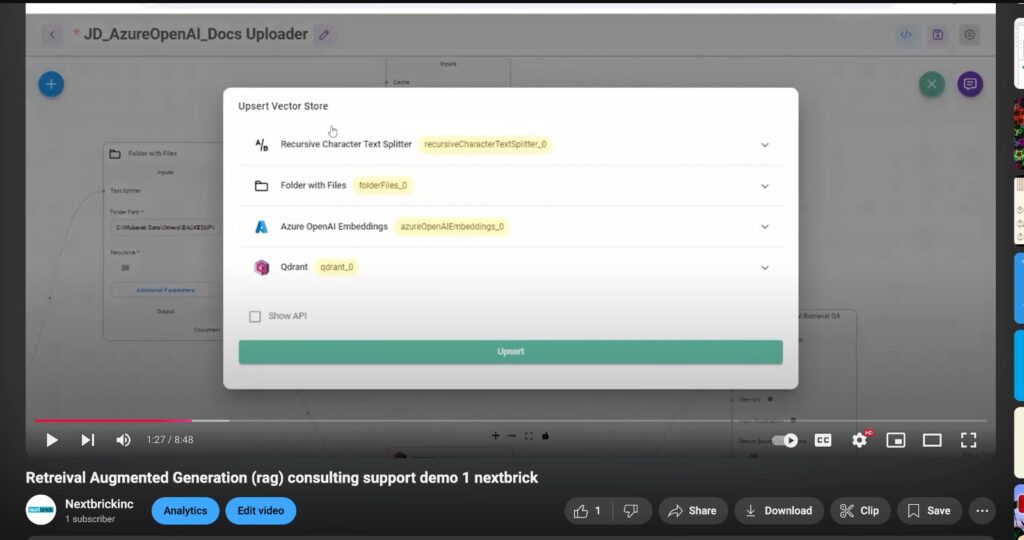
Retrieval Augmented Generation (RAG) Consulting Support Services
For Expert Retrieval Augmented Generation (RAG) & Consulting Support
Get in touch with us
Contact Us
Email Us
Building a Retrieval-Augmented Generation (RAG) Solution
Retrieval-Augmented Generation (RAG) is a powerful technique that combines the strengths of large language models (LLMs) and information retrieval to generate more accurate, relevant, and informative responses. By leveraging a knowledge base, RAG systems can access and process relevant information, ensuring that the generated content is grounded in factual data.
– Gather diverse data sources (text, images, audio, video)
– Preprocess data (cleaning, deduplication, PII handling)
Data Cleaning: Clean and preprocess the data to remove noise, inconsistencies, and irrelevant information.
Data Chunking: Break down large documents into smaller, manageable chunks. This can be done based on semantic meaning, paragraph boundaries, or fixed-size chunks.
– Implement multimodal chunking strategies
– Select or fine-tune embedding models for different modalities
– Generate embeddings for all data types
– Experiment with domain-specific embedding models
– Choose a scalable vector database (e.g., Pinecone, Weaviate, Quadrant , MongoDB, Elasticsearch)
– Index embeddings with metadata
– Implement hybrid search capabilities (dense and sparse retrieval)
– Develop query understanding and intent classification
– Implement query expansion and reformulation techniques
– Create multimodal query handling (text, image, voice inputs)
– Implement dense retrieval with customizable parameters
– Develop re-ranking algorithms for improved relevance
– Create ensemble retrieval methods combining multiple strategies
Search Mechanism: Implement hybrid search methods (dense + sparse retrieval) for optimal results
– Design dynamic prompt engineering techniques
– Implement iterative retrieval for complex queries
– Develop context fusion methods for multimodal data
– Select and integrate appropriate LLMs ( OpenAI GPT-4 Anthropic Claude
Google PaLM ,Mistral AI ,Open-source models (LLaMA, Falcon)) for various use cases
– Implement model switching based on query complexity
– Develop fine-tuning pipelines for domain-specific tasks
– Implement multi-step reasoning for complex queries
– Develop fact-checking and hallucination detection mechanisms
– Create response formatting for different output modalities
– Implement comprehensive evaluation metrics (relevance, coherence, factuality)
– Develop feedback loops for continuous improvement
– Optimize system performance and latency
– Design a modular, microservices-based architecture
– Implement caching and load balancing strategies
– Develop monitoring and logging systems for production environments
– Create intuitive interfaces for various use cases (chatbots, search engines, recommendation systems)
– Develop APIs for easy integration with existing systems
– Implement user feedback mechanisms for system improvement
– Implement data encryption and access control measures
– Ensure compliance with relevant regulations (GDPR, CCPA)
– Develop audit trails for data usage and model decisions
~ Testimonials ~
Here’s what our customers have said.
Empowering Businesses with Exceptional Technology Consulting